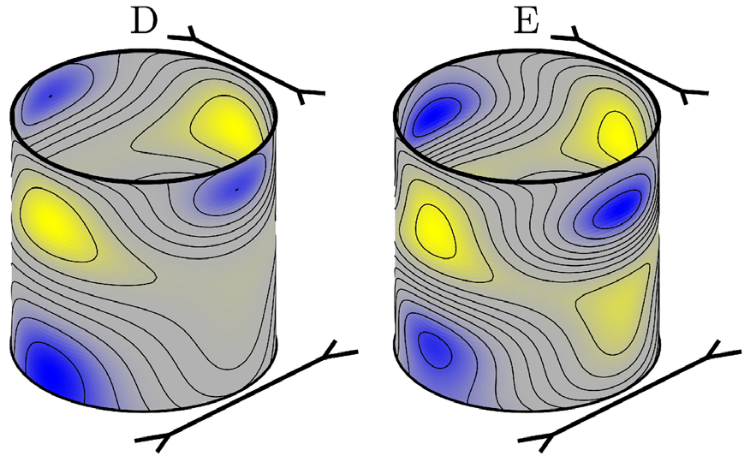
Pattern Formation Mechanisms in Transitional Shear Flows
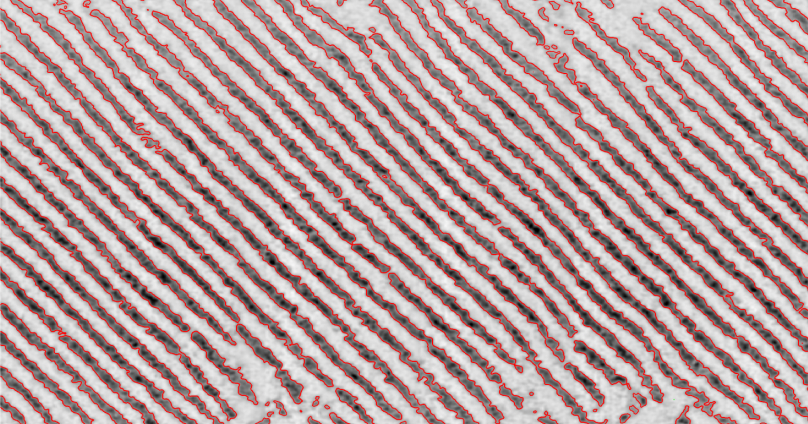
The co-existence of laminar and turbulent flow regions, commonly referred to as spatio-temporal intermittency, is intrinsic to the onset of turbulence and can be observed in a wide range of situations including flows through pipes, boundary layers, channels and fluid layers sheared between parallel walls or concentric cylinders, respectively Couette and Taylor-Couette flows.
Indeed, classic stability analysis of the governing equations only confirms the linear stability of the laminar base flow but provides no insight into the onset of turbulence, let alone stripe patterns.
By means of several numerical techniques such as Direct Numerical Simulation (DNS) and post-processing of the fields, I study the mechanisms responsible for this pattern formation.
Computation and Analysis of Exact Coherent Structures
Transition to turbulence in shear flows is characterised by intermittency, i.e., the coexistence of laminar and turbulent flow regions. Despite the linear stability of the base flow, finite amplitude perturbations trigger the intermittent proliferation and decay of localized turbulent structures in the form of spots, stripes or bands. Several recent works have reported the importance of localised Exact Coherent Structures (ECS) in the sustenance and maintenance of such turbulent patterns.
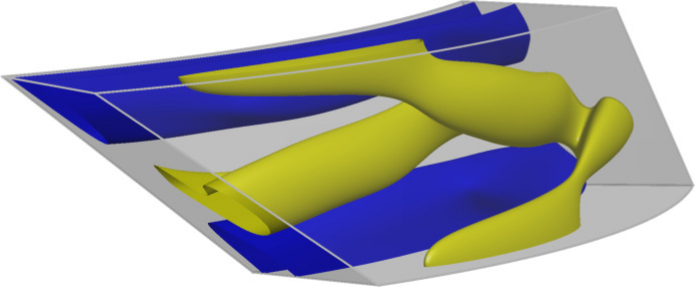
Moreover, the ECS emanated from saddle-node bifurcations typically dictate the topology and amplitude of flow perturbations that are capable of triggering transition, thus proving its importance in the transitional regimes.
Extensional Flows
Despite their apparent simplicity, extensional flows, i.e., flows between extensional plates or membranes, play a crutial role in many industrial applications such as cooling and extrusion processes, paper production, polymer processing, and metallurgy. Furthermore, these type of flows are used to mathematically model certain physiological processes arising
in cardiology, as they can mimmic the flow in blood vessels.
For this reason, I explore the stability and dynamical relevance of a wide variety of steady, time-periodic, quasiperiodic, and chaotic flows arising between stretching and shrinking membranes.